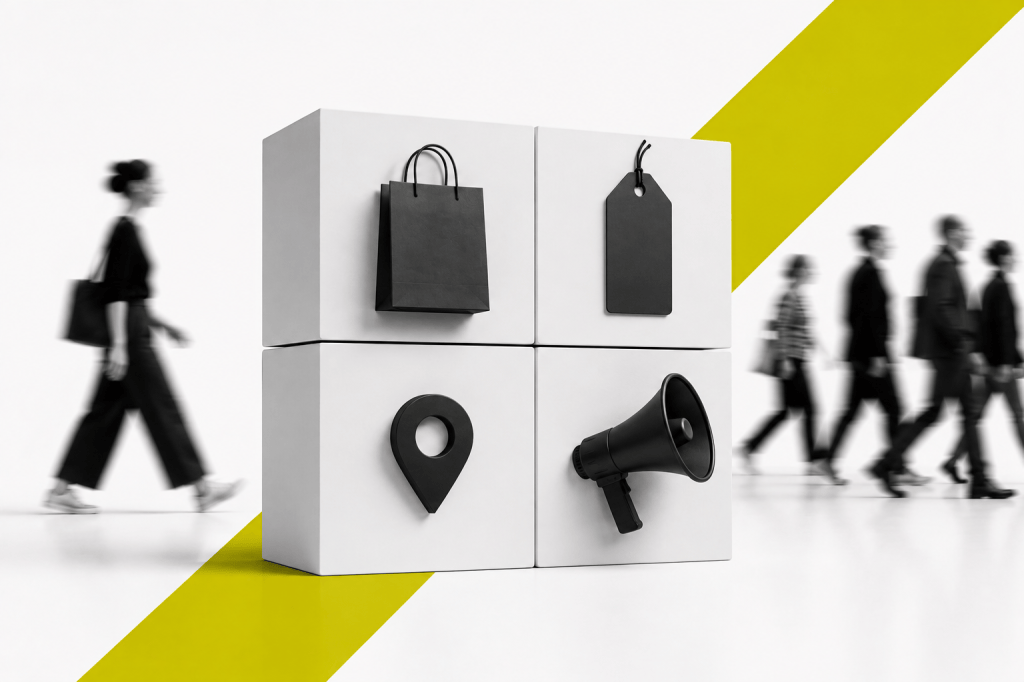
What happens when Product, Price, Place and Promotion are no longer enough?
The 4Ps haven’t become irrelevant. Our questions about them have changed.
Product.
Price.
Place.
Promotion.
For decades, the 4Ps have given marketers a simple framework for thinking about how value gets created and delivered.
And they still work.
But the world around them has changed.
We are no longer making marketing decisions in a system where the only question is how to sell more, faster and more efficiently.
We also have to think about resources, accessibility, behaviour, long-term value and the wider consequences of the choices we make.
So perhaps the framework doesn’t need to disappear.
Perhaps it needs better questions.
Product: What are we actually creating?
The traditional question is:
What product does the market want?
A broader question might be:
What value are we creating — and what does it take to create it?
That can change the conversation around product design.
Longevity.
Repairability.
Materials.
Reuse.
Services instead of ownership.
Products that solve a genuine need rather than simply creating another reason to consume.
The product is still the product.
But we’re looking at its entire lifecycle rather than stopping at the moment of purchase.
Price: Who gets access to the better choice?
Price has always been about positioning, profitability and willingness to pay.
But price also determines accessibility.
If a better alternative is only available to people who can afford a premium, how quickly can that solution really scale?
This doesn’t mean every responsible choice has to be cheaper.
It means that pricing decisions can be part of the impact a brand creates.
Who can access what we’re offering?
What behaviours does our pricing encourage?
Are we rewarding the behaviour we actually want to see?
Those are marketing questions too.
Place: Where and how does value reach people?
Distribution is easy to overlook because it happens behind the scenes.
But where a product is available — and how it gets there — shapes who can access it, how convenient it is and what resources are required along the way.
Digital products have changed this equation dramatically.
So have local production, direct-to-consumer models, sharing platforms, refill systems and circular business models.
The question isn’t only:
“Where can we sell this?”
It can also be:
“What is the most useful way to make this available?”
Promotion: What are we making desirable?
This is perhaps where marketing has the most obvious influence.
Promotion doesn’t just communicate a product.
It helps shape perceptions of what is desirable, normal and aspirational.
Which means we can ask more than:
How do we convince people to buy this?
We can ask:
What behaviour are we encouraging?
What values are we reinforcing?
Could we make a better choice feel equally desirable?
This connects directly to one of the biggest opportunities for modern marketing: using creativity not simply to drive consumption, but to help make new behaviours and solutions attractive and culturally relevant.
The 4Ps still matter. The context has changed.
I don’t think marketers need another framework.
We already have plenty.
The 4Ps are useful precisely because they’re simple.
But simplicity shouldn’t mean stopping at the first question.
Product isn’t just what we sell.
Price isn’t just what we charge.
Place isn’t just where we distribute.
Promotion isn’t just what we say.
Each one influences the kind of value a business creates — and the behaviours it makes possible.
marketing needs to move beyond simply stimulating demand and consider its role in creating long-term value, including the social and environmental systems businesses depend on.
So perhaps the evolution isn’t about replacing the 4Ps.
It’s about adding a few more questions to each one.
What value?
For whom?
For how long?
At what cost — beyond the financial one?
Because the fundamentals of marketing haven’t necessarily changed.
But what we consider a successful outcome has.


Leave a comment